NEED TO KNOW: The most important facts, stats and trivia ahead of the 2026 Dutch Grand Prix
As F1 heads to Zandvoort for the Dutch Grand Prix, Need to Know is your all-in-one guide with statistics, driving pointers, strategy tips and more.
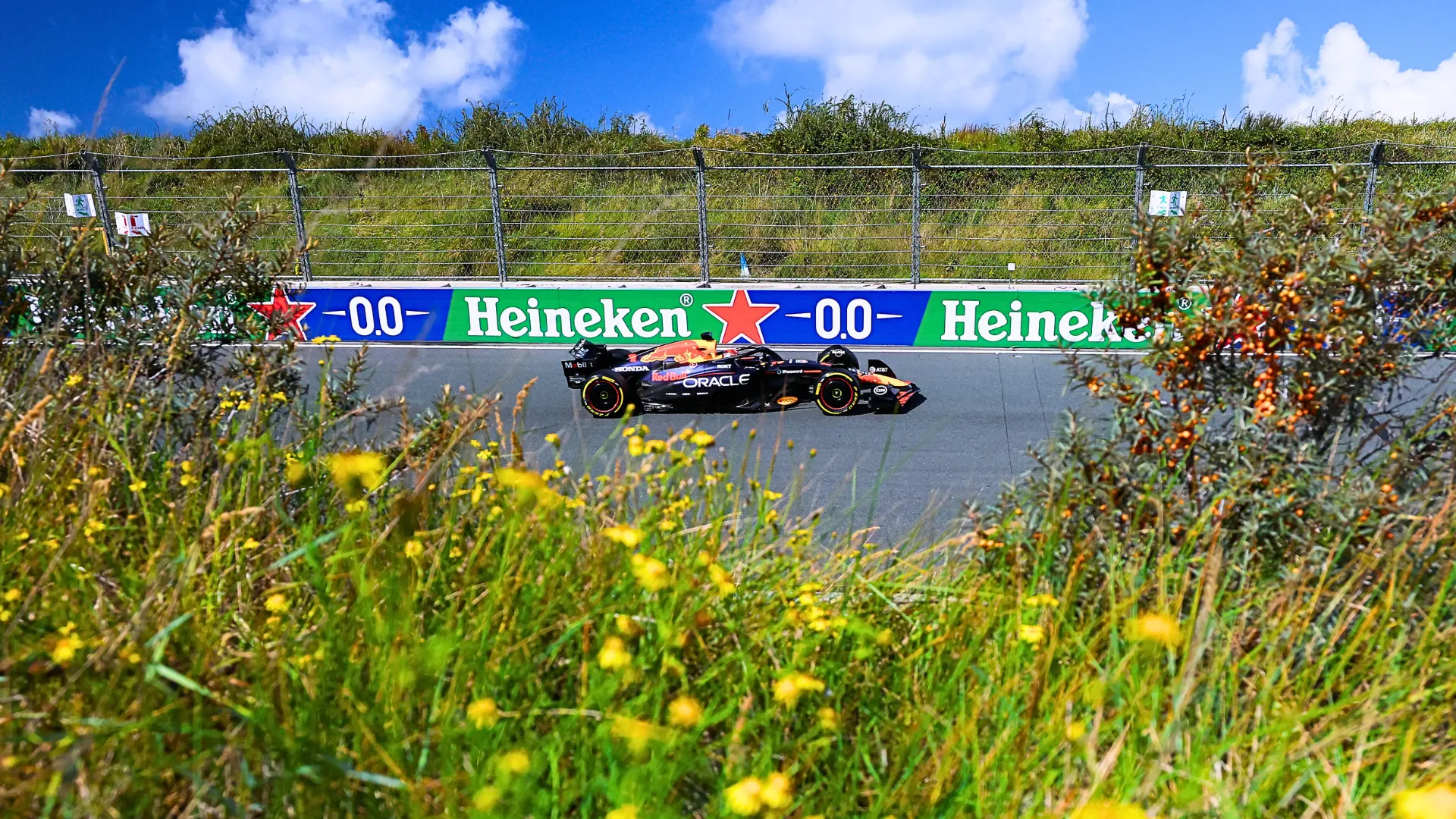
The 2026 Formula 1 season resumes this weekend with Round 12 on the calendar, the Dutch Grand Prix.
As the Sprint format makes its fourth appearance of the campaign, Free Practice 1 and Sprint Qualifying will take place on Friday, August 21, followed by the Sprint and Qualifying on Saturday, August 22, and the Grand Prix itself on Sunday, August 23.
Vital Statistics
- First Grand Prix – 1952
- Track Length – 4.259km
- Lap record – 1m 11.097s, Lewis Hamilton, Mercedes, 2021
- Most pole positions – Rene Arnoux/Max Verstappen (3)
- Most wins – Jim Clark (4)
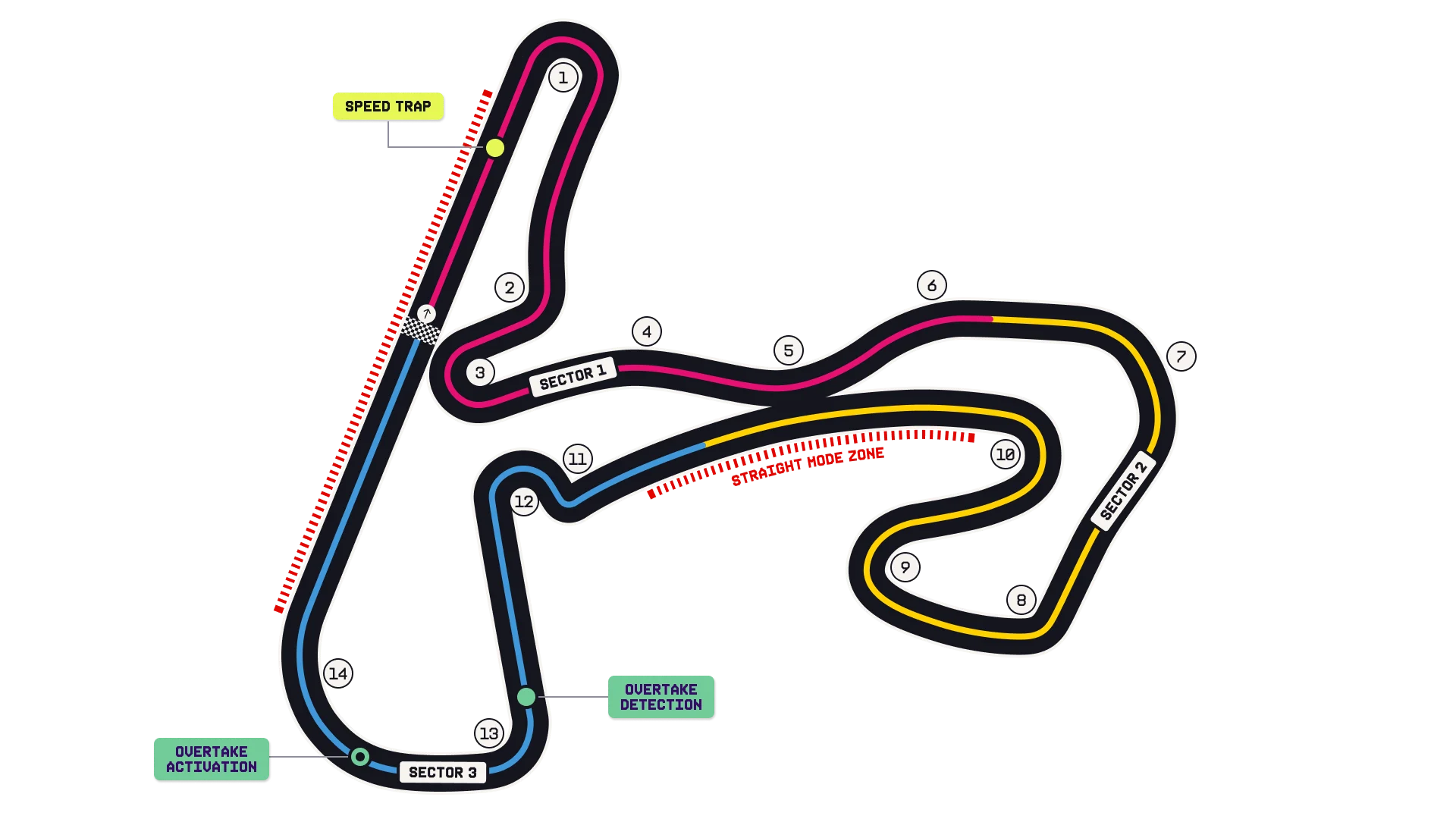
- Trivia – Zandvoort’s final corner – named after Dutch motorsport legend Arie Luyendyk – features 18-degrees of banking, almost double the numbers seen at the Indianapolis Motor Speedway
- Pole run to Turn 1 braking point – 197 metres
- Overtakes completed in 2025 – 70
- Safety Car probability – 60%*
- Virtual Safety Car probability – 60%*
- Pit stop time loss – 18.09 seconds
*From the last five races in the Netherlands
The driver's verdict
Jolyon Palmer, former Renault F1 driver: I’ve only done this one on a bike! Zandvoort is actually a lovely circuit that has been adapted really well for modern F1. It’s still difficult to overtake on, as expected with an old design of track, but the banking makes a huge difference.
You don’t really appreciate the banking until you go around it at Turn 3. The theory is multiple lines, but everyone just bolts for the outside line and tries to get the exit right. And again, coming through the final corner as well, running the banking.
It is a nice, flowing track. You’ve got to have commitment, particularly in the middle sector, which is undulating, and you’ve got to just have it hooked up in the high speed sections. You don’t want to be having random snaps of oversteer, because it’s a punishing circuit as well...
Last five Dutch GP polesitters
- 2025 – Oscar Piastri (McLaren)
- 2024 – Lando Norris (McLaren)
- 2023 – Max Verstappen (Red Bull)
- 2022 – Max Verstappen (Red Bull)
- 2021 – Max Verstappen (Red Bull)
Last five Dutch GP winners
- 2025 – Oscar Piastri (McLaren)
- 2024 – Lando Norris (McLaren)
- 2023 – Max Verstappen (Red Bull)
- 2022 – Max Verstappen (Red Bull)
- 2021 – Max Verstappen (Red Bull)
Tyre and strategy insight
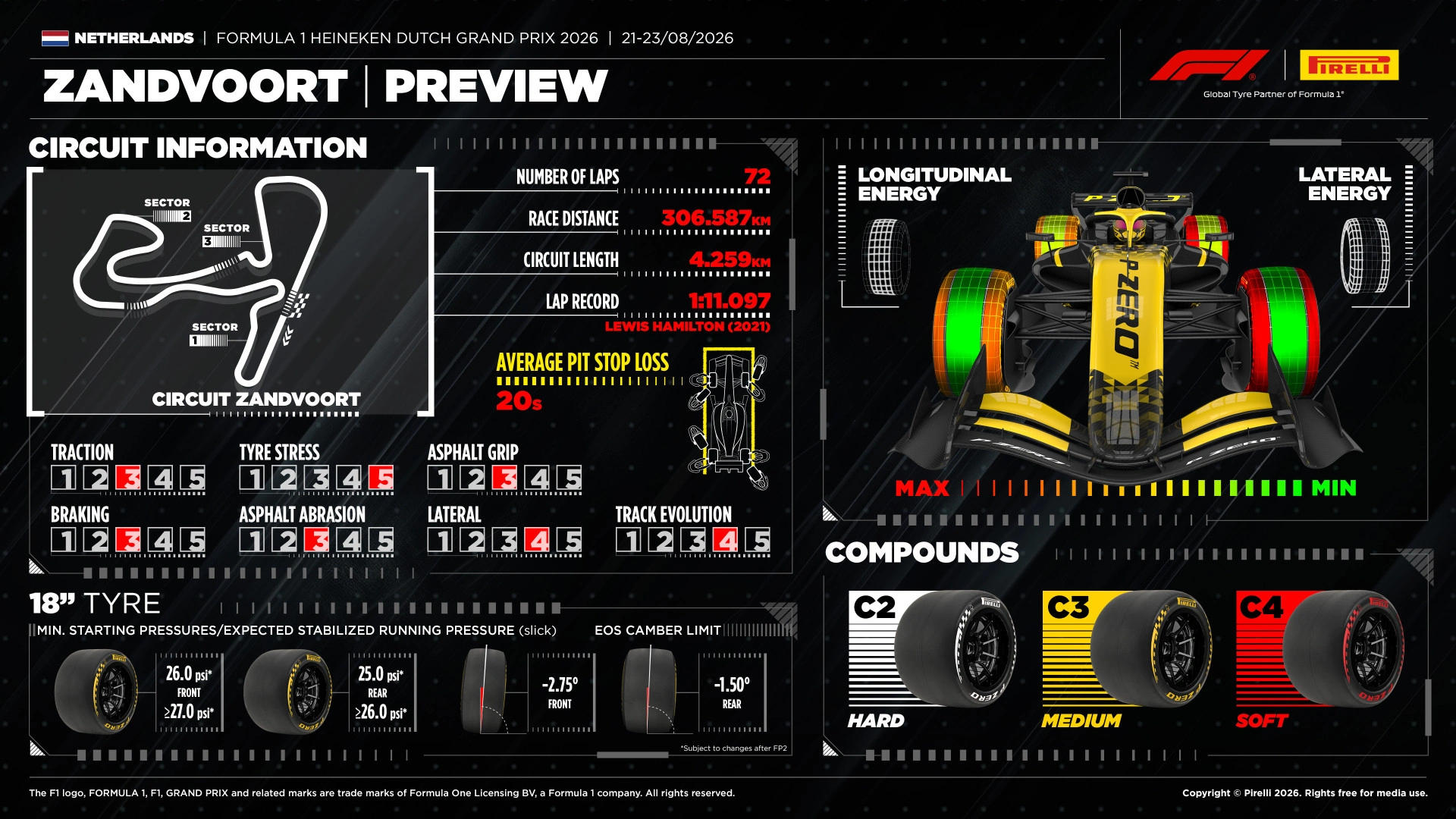
“The track, situated just 40 km from Amsterdam, offers a low level of grip both because of the nature of its asphalt, which has been resurfaced in several sections over the years, and because of the sand blown onto the circuit from the nearby beaches,” Pirelli’s weekend preview reads, with the tyre compounds available for the event confirmed as the C2 (hard), C3 (medium) and C4 (soft).
“This phenomenon can reduce grip not only from one day to the next, but sometimes even from one session to another.
“The Zandvoort circuit is particularly demanding on tyres in terms of energy density, owing to its short lap length and numerous corners, some of them taken at high speed. The two banked turns, with gradients of 19 and 18 degrees respectively, generate extremely high vertical and lateral forces on the tyres.
“Teams therefore need to manage car set-up carefully and, more generally, the interaction between car and tyres. The level of aerodynamic downforce required is high, very similar to that needed at Budapest, venue of the final round before the summer break.
“The Dutch round has been brought forward by one week compared to 2025. In theory, thermal degradation should play a significant role in the middle of August, but temperatures at Zandvoort rarely exceed 20C and rain is a frequent feature. In addition, the circuit’s proximity to the sea means strong gusts of wind are common, which could affect the drivers, especially with the new aerodynamic regulations.
“With the Sprint format making its debut at Zandvoort, teams will have only one hour of free practice available to finalise their car set-ups. While the hard is likely to be the reference compound for Sunday’s race, the two softer options could both prove effective choices for Saturday’s Sprint. Overtaking difficulty, caused by the presence of only one straight and the narrow track width, will also be an important factor in Grand Prix strategy.”
Current form
As the season resumes following F1’s traditional summer break, Kimi Antonelli continues to lead the Drivers’ Championship – but the recent form of Mercedes’ rivals has resulted in an increasingly competitive fight at the front, meaning that it is tough to predict who could come out on top this weekend.
Lando Norris claimed McLaren’s first win of the campaign last time out in Hungary – and having hailed the performance as “the best pace I’ve ever had”, the Briton is hopeful that it will not be his and the team’s last win this season.
There have also been signs of progress over at Red Bull, with Max Verstappen claiming back-to-back podiums at Spa-Francorchamps and the Hungaroring. Given that this weekend marks the last Dutch Grand Prix, the four-time World Champion will be hoping to give his local fans something to cheer about.
In terms of the standings, however, both McLaren and Red Bull are still some distance away from Mercedes and Ferrari. Antonelli holds a 50-point advantage over Lewis Hamilton, while Charles Leclerc trails third-placed George Russell by 22 points.
Each of these drivers has claimed one win apiece across the last five rounds on the calendar – and with Antonelli conceding in Budapest that the rest of the year would be a “development race”, the battle is likely to persist across the second half.
As for the rest of the pack, Racing Bulls will be looking to maintain the P5 they climbed to in Hungary, while Aston Martin – who brought a long-awaited upgrade package last time out – are hoping to take further steps with a power unit update this weekend. Cadillac, meanwhile, arrive into the event with a new Team Principal in the form of Marcin Budkowski – but can the squad move nearer to scoring their debut points in F1?
Iconic moment
James Hunt claimed 10 Grand Prix wins during an F1 career that spanned most of the 1970s, and the first of them was a piece of history not just for himself, but also the plucky Hesketh upstart team he represented.
In a 1975 encounter that started on a damp track but soon shifted to dry conditions, Hunt pitted after seven laps to change his wet tyres for slicks, but many others – including pole-sitting Ferrari driver Niki Lauda – initially stayed out.
Once the rest of the field had eventually pitted, Hunt found himself in the giddy heights of P1 – a position Lauda was desperate to reclaim. However, the inimitable Briton could not be stopped as he logged his maiden F1 win and the one-and-only triumph for Lord Hesketh’s operation.
It was a remarkable, feel-good underdog tale, with the mighty Ferrari toppled by a fledgling force, and it remains at the head of the list when it comes to iconic moments at the Dutch Grand Prix.
Watch how it all unfolded in the video player below...
Next Up
Related Articles
 Audi unveil special livery for Singapore GP
 ‘It’s happened too many times’ – Russell on Bahrain DNF
 Vasseur on how Hamilton and Leclerc saved the day at Sepang
 OFFICIAL GRID: Who starts where for the Bahrain GP in Malaysia
/Leclerc%20header%20central.webp) Leclerc relieved with P4 after everything went ‘wrong’ in Sepang
Leclerc relieved with P4 after everything went ‘wrong’ in Sepang/Bahrain%20finish.webp) AS IT HAPPENED: Verstappen wins epic Bahrain GP in Malaysia
AS IT HAPPENED: Verstappen wins epic Bahrain GP in Malaysia