After an action-packed weekend in Canada, the teams and drivers are heading to Monaco for the sixth round of the season – and tyre suppliers Pirelli have revealed the compounds available for use at the historic track.
The allocation is identical to that provided in both Miami and Canada, with teams receiving the softest compounds in the range for this year’s running at the Circuit de Monaco. C3 will be the hard tyre option, C4 the medium, and C5 the red-walled soft tyre.
Drivers will get two sets of the hard tyre (marked white), three sets of the medium tyre (marked yellow), and eight sets of the soft tyre (marked red), as well as access to the green intermediate tyre and the blue full wets, should they be required.
An extra set of softs is reserved for those who reach Q3 in Qualifying, while all drivers must use at least two different slick compounds during the race, providing the track is dry.
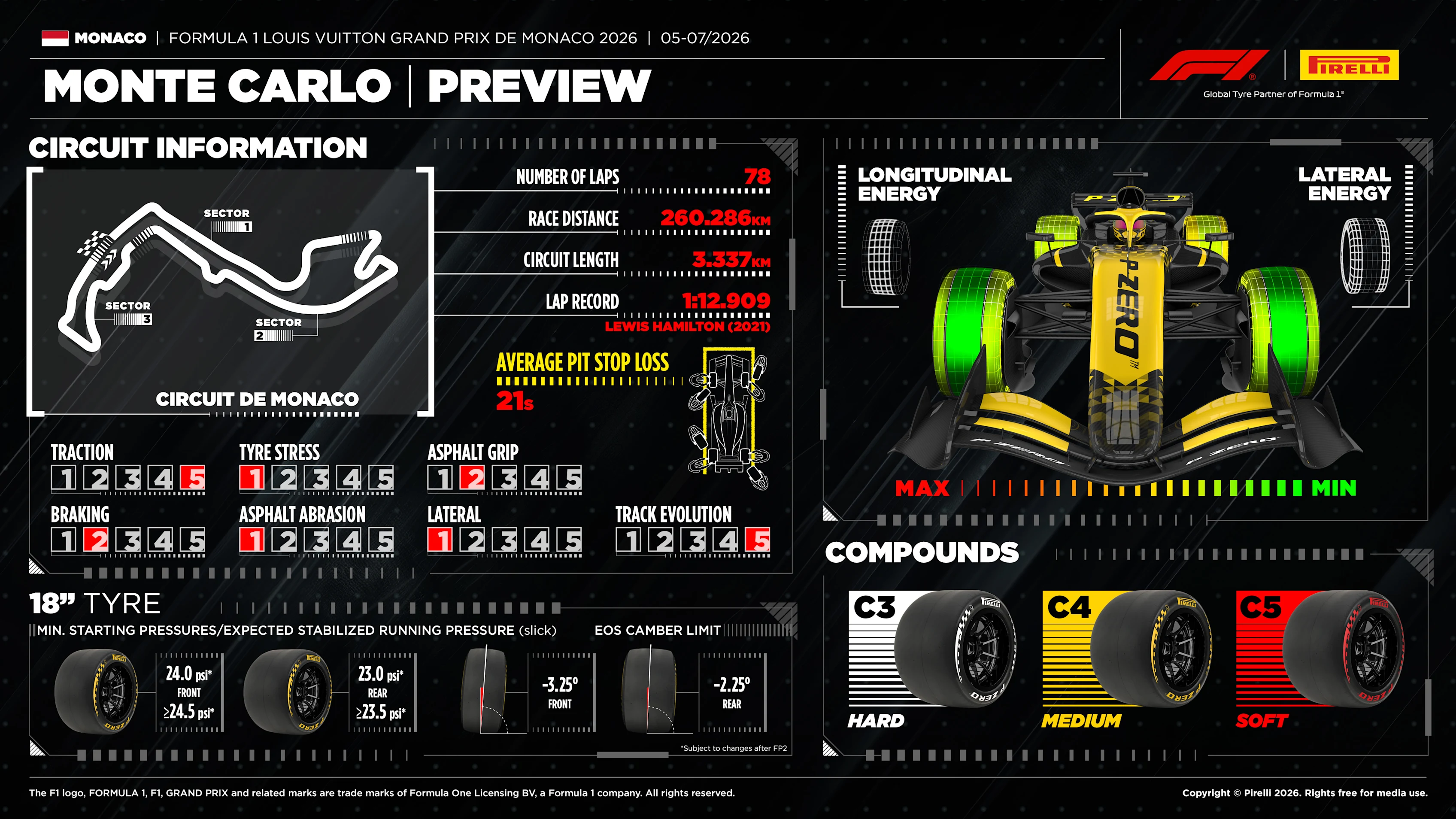
“The Monaco Grand Prix is not just a sporting event, but also a social highlight that brings together history and glamour,” reads Pirelli’s weekend preview. “The circuit, which has hosted racing since 1929, winds its way through the streets of the Principality: it measures 3.337 kilometres and features 19 corners, some of them characterised by extremely tight angles.
“The carriageway, which essentially coincides with the two lanes of normal urban traffic, is extremely narrow and almost entirely lacking run-off areas. Safety barriers line the entire track and are often brushed by the drivers, who try to gain even a few centimetres by following the ideal racing line.
“The average speed maintained over the 78 laps of the circuit is the lowest of the Formula 1 World Championship: in some sections the cars slow to around 50 km/h. From a technical point of view, the Monaco weekend is among the most complex for the teams, who are required to set up their cars with maximum aerodynamic downforce and to focus everything on qualifying in order to secure a good grid position, given that overtaking opportunities are extremely limited.
“For Monaco, the softest tyre range is always selected, this year C3, C4 and C5, to ensure maximum grip on a very smooth asphalt surface. For this edition, the road surface has been resurfaced between Turns 19 and 1, between Turn 7 and the entrance to the tunnel, as well as on the entry to and exit from the pit lane. Graining may occur, but it should not significantly affect tyre behaviour, as in the Principality the tyres are subjected mainly to traction-related loads.
“The low level of tyre degradation on the Monaco track traditionally results in a one-stop race. An exception was last year, when the FIA introduced an experimental regulatory change obliging drivers to use at least three different sets of tyres, thereby enforcing at least two pit stops. The rule was subsequently abandoned and the classic format returns.
“Strategies are influenced above all by neutralisations and red flags, which are quite frequent given the high probability of contact with the barriers and the difficulty of removing cars without interrupting the race. In 2024, for example, a red flag on the opening lap allowed all drivers to immediately comply with the requirement to use both compounds, making it possible to complete the remainder of the Grand Prix with a split strategy between Medium and Hard.”
For more information about Pirelli’s F1 tyres, visit pirelli.com.
Next Up